

Esta publicación también está disponible en:
¿Adolf Hitler intentó detener el pogromo Kristallnacht?
Para exonerar a Hitler, los negacionistas del Holocausto declaran:
When Adolf Hitler found out about the Kristallnacht pogrom he was angry and ordered Josef Goebbels, the Minister of Propaganda, to stop it immediately.
For example, David Irving, who the High Court in London in 2000 declared to be a Holocaust denier, racist and antisemite, claims that when Hitler found out about the pogrom he was “livid with rage.” He summoned Josef Goebbels, the Minister of Propaganda, to his apartment and “made a terrible scene.”[1] Irving states that Hitler sent out Julius Schaub, one of his aides, with instructions to do everything possible to stop the violence and destruction. Hitler then ordered Goebbels and Rudolf Hess, the head of the Nazi party and part of Hitler’s inner circle, to the phones to try to “halt the most violent excesses.”[2]
Los hechos son:
La evidencia histórica no respalda la idea según la cual cuando Adolf Hitler se enteró del pogromo de Kristallnacht intentó detenerlo. Las notas del diario de Josef Goebbels, el ministro de propaganda y miembro del círculo íntimo de Hitler, muestran que Hitler no le pidió que detuviera el pogromo, sino que lo autorizó.
Los hechos sobre si Adolf Hitler trató de detener el pogromo Kristallnacht:
Goebbels’ diary reveals that a supposedly enraged Hitler did not send him out to stop the pogrom. Instead, Goebbels was free to revel in his initial progress. Later, after an evening event where he met with Hitler, Goebbels happily recorded the scene he witnessed from his car as he returned to his hotel: “In Berlin, 5 then 15 synagogues burn down. Now the people’s anger rages. Nothing more can be done against it for the night. And I don’t want to do anything either. Should be given free rein . . . As I drive to the hotel, windows shatter. Bravo! Bravo! The synagogues burn in all big cities. German property is not endangered.”[3] Goebbels’ euphoria continued into the next day (November 10). “Yesterday, Berlin. There, all proceeded fantastically. One fire after another. It is good that way. I prepared an order to put an end to the actions. It is now just enough . . . In the whole country the synagogues have burned down. I report to the Führer at the Osteria.”[4]
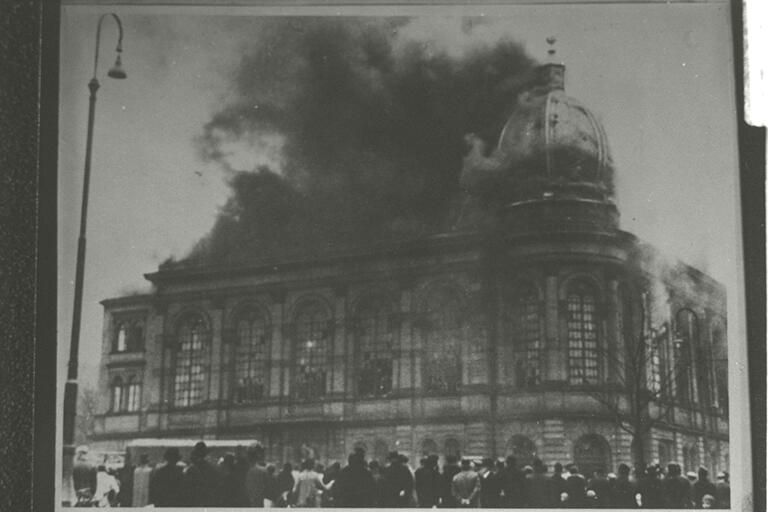
Center for Jewish History, NYC [No restrictions or Public domain], via Wikimedia Commons

Las notas del diario de Goebbels revelan que Hitler no le ordenó que detuviera el pogromo. Al contrario, Goebbels tenía una cita para almorzar con Hitler el día siguiente para evaluar el impacto del pogromo.
La implementación del pogromo Kristallnacht: principal evidencia
El hecho que Hitler no dio órdenes para detener el pogromo se evidencia en tres telegramas sobre la ejecución de este. Los oficiales nazis de alto rango enviaron estos telegramas a sus subordinados en Alemania durante la noche de Kristallnacht.
El telegrama del 9 de noviembre de 1938 a las 11:55 p.m.
Heinrich Müller envió un telegrama desde Berlín a la policía alemana con instrucciones sobre el pogromo. Su telegrama decía: “Muy pronto, se emprenderán acciones contra los judíos, en particular, contra sus sinagogas, en toda Alemania. No deben interrumpirse”. Se debía evitar los saqueos. Se autorizó la detención de 20,000 a 30,000 judíos. “Se debe elegir antes que nada a los judíos con propiedades”.[5]
El telegrama del 10 de noviembre de 1938 a la 1:20 a.m.
Reinhard Heydrich trasmitió órdenes desde Berlín a las fuerzas policiales y a las oficinas de la Gestapo en todo el país. Él había recibido las órdenes directamente de su jefe, Heinrich Himmler (el jefe de las SS y de la policía en Alemania), quien reportaba directamente ante Hitler.
Este telegrama ordenaba a la policía que no evitara la destrucción de las propiedades judías ni que tampoco interfiriera con los actos violentos contra los judíos alemanes. Este telegrama decía: “…se esperan manifestaciones contra los judíos durante esta noche —9 y 10 de noviembre 1938— en todo el Reich… las manifestaciones no deben ser reprimidas por la policía”.[6]
Las únicas restricciones reales que Himmler y Heydrich solicitaron a la policía y la Gestapo fueron que evitasen daños a las propiedades o a la vida de los alemanes. Solo se prenderá fuego a las sinagogas si no hay riesgo de que se extienda a los edificios de los “arios”. No se deben realizar saqueos en las tiendas y las viviendas de los judíos. Se debe proteger las tiendas que no sean de propiedad judía. Los judíos extranjeros no deben ser asaltados.
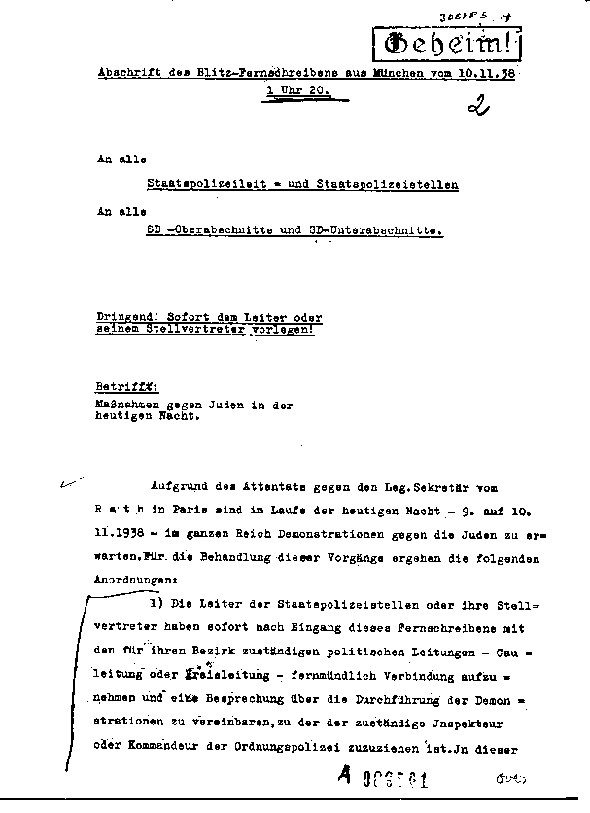
Telex signed by Reinhard Heydrich (page 1 of 4). National Archives [Public Domain], via Wikimedia Commons.

The telex on November 10, 1938 at 2:56 a.m.
Rudolf Hess sent out a cable to all the party offices throughout Germany. This telex forbade setting fire to Jewish shops: “On express orders issued at the very highest level, there are to be no kind of acts of arson or outrages against Jewish property or the like on any account and under any circumstances whatsoever.”[7] Forbidding the arson of Jewish shops was probably due to the fact that many Jews rented from non-Jews. Thus, burning these shops would actually destroy German property. There was also a risk that the fires would spread to adjacent German property. Finally, it became clear after the pogrom that the Nazis wanted to «Aryanize» the last Jewish-owned businesses in Germany—that is, the Nazis wanted to take them over and provide them to the so-called «Aryan» proprietors. In light of this eventual «Aryanization,» burning the shops and their contents would be counterproductive and wasteful in the long run.[8]
Conclusión:
Las notas del diario de Josef Goebbels, un miembro del círculo íntimo de Hitler, indican que Hitler no pidió que se detenga el pogromo, sino que en realidad lo autorizó. El diario de Goebbels revela que estaba encantado ante el progreso del pogromo durante la noche. Cuando se encontró con Hitler al día siguiente, solo ultimaron los detalles sobre cómo finalizar el pogromo. Ningún otro oficial nazi, incluidos otros en el círculo íntimo de Hitler, trató de detener el pogromo. Al contrario, enviaron instrucciones durante la noche de Kristallnacht, dando indicaciones sobre cómo llevar a cabo el pogromo con más eficiencia. Ninguno de estos oficiales nazis se hubiera atrevido a realizar actos violentos contra los judíos alemanes sin el permiso de Hitler.
NOTES
[1] David Irving, Goebbels: Mastermind of the Third Reich (Focal Point, 1996), p. 277. You may download the entire book as a PDF at www.fpp.co.uk/books/Goebbels/.
[2] David Irving, War Path (London 1978), p. 165 as cited in Richard J. Evans, David Irving, Hitler and Holocaust Denial, (4)(4.3)(c)(ii)(E)(2-4) at www.hdot.org, “Expert Witness Reports.” Warpath can be downloaded as a PDF at http://www.fpp.co.uk/books/WarPath/.
[3] Richard J. Evans, David Irving, Hitler and Holocaust Denial, Section (4)(4.3)(c)(ii)(E)(10).
[4] Richard J. Evans, David Irving, Hitler and Holocaust Denial, Section (4)(4.3)(c)(iii)(A)(4).
[5] Richard J. Evans, David Irving, Hitler and Holocaust Denial, Section (4)(4.3)(c)(ii)(F)(9).
[6] Richard J. Evans, David Irving, Hitler and Holocaust Denial, Section (4)(4.3)(c)(ii)(F)(2).
[7] Richard J. Evans, David Irving, Hitler and Holocaust Denial, Section (4)(4.3)(c)(ii)(G)(1).
[8] Richard J. Evans, David Irving, Hitler and Holocaust Denial, Section (4)(4.3)(c)(ii)(G)(2-4).