

Bu yayın şu dillerde de okunabilir:
Adolf Hitler, Kristallnacht pogromunu durdurmaya çalıştı mı?
Holokost inkârcıları Hitler'i aklama yolu olarak şunu iddia etmektedir:
When Adolf Hitler found out about the Kristallnacht pogrom he was angry and ordered Josef Goebbels, the Minister of Propaganda, to stop it immediately.
For example, David Irving, who the High Court in London in 2000 declared to be a Holocaust denier, racist and antisemite, claims that when Hitler found out about the pogrom he was “livid with rage.” He summoned Josef Goebbels, the Minister of Propaganda, to his apartment and “made a terrible scene.”[1] Irving states that Hitler sent out Julius Schaub, one of his aides, with instructions to do everything possible to stop the violence and destruction. Hitler then ordered Goebbels and Rudolf Hess, the head of the Nazi party and part of Hitler’s inner circle, to the phones to try to “halt the most violent excesses.”[2]
Gerçekler şunlardır:
Tarihi kanıtlar, Adolf Hitler'in Kristallnacht pogromundan haberdar olunca, bunu durdurmaya çalıştığı iddiasını desteklememektedir. Propaganda Bakanı ve Hitler'in yakın çevresindekilerden olan Josef Goebbels'in günlüklerinde, Hitler'in kendisine pogromu durdurma emri vermediği, bilakis pogroma izin verdiği görülmektedir.
Adolf Hitler'in Kristallnacht pogromunu durdurmaya çalışıp çalışmadığına dair gerçekler:
Goebbels’ diary reveals that a supposedly enraged Hitler did not send him out to stop the pogrom. Instead, Goebbels was free to revel in his initial progress. Later, after an evening event where he met with Hitler, Goebbels happily recorded the scene he witnessed from his car as he returned to his hotel: “In Berlin, 5 then 15 synagogues burn down. Now the people’s anger rages. Nothing more can be done against it for the night. And I don’t want to do anything either. Should be given free rein . . . As I drive to the hotel, windows shatter. Bravo! Bravo! The synagogues burn in all big cities. German property is not endangered.”[3] Goebbels’ euphoria continued into the next day (November 10). “Yesterday, Berlin. There, all proceeded fantastically. One fire after another. It is good that way. I prepared an order to put an end to the actions. It is now just enough . . . In the whole country the synagogues have burned down. I report to the Führer at the Osteria.”[4]
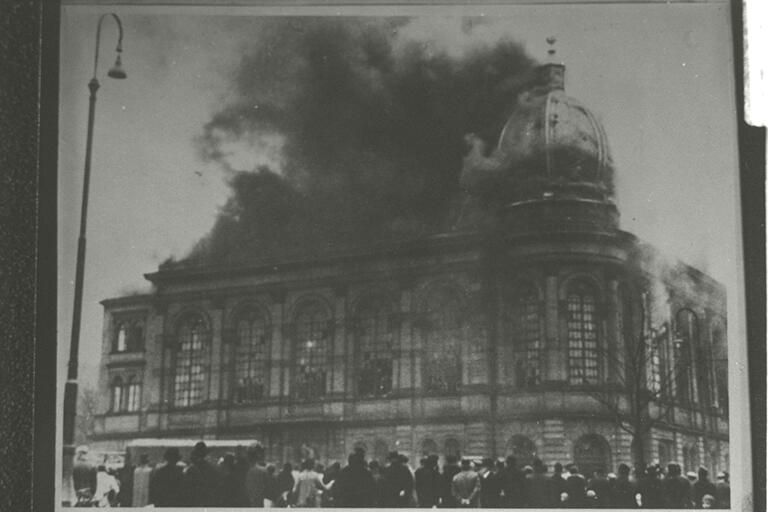
Center for Jewish History, NYC [No restrictions or Public domain], via Wikimedia Commons

Goebbels'in günlüklerinde yazanlar, Hitler'in ona pogromu durdurma emri vermediğini göstermektedir. Bilakis, Goebbels pogromun etkisini gözden geçirmek için ertesi gün Hitler'le öğle yemeğinde buluşmuştur.
Kristallnacht pogromunun uygulanması: Birincil kanıt
Hitler'in pogromu durdurma emri vermediği, pogromun uygulanmasıyla ilgili üç teleksle (telgraf) ispatlanmıştır. Üst düzey Nazi yetkilileri bu teleksleri Kristallnacht esnasında Almanya'daki tüm astlarına göndermiştir.
9 Kasım 1938 günü, akşam saat 23.55'te gönderilen teleks
Heinrich Müller, Berlin'den Alman polis yetkililerine pogromla ilgili talimatlar içeren bir teleks göndermiştir. Müller'in teleksinde kısmen şunlar yazıyordu: "Yahudilere, bilhassa sinagoglarına karşı düzenlenen eylemler kısa süre içinde tüm Almanya'ya yayılacaktır. Bu eylemlere müdahale edilmemelidir." Yağmacılık engellenecektir. 20.000 ila 30.000 Yahudi'nin tutuklanmasına izin verilmiştir. "Özellikle varlıklı Yahudiler seçilecektir."[5]
10 Kasım 1938 günü, gece saat 01.20'de gönderilen teleks.
Reinhard Heydrich, Berlin'den ülke çapındaki polis güçlerine ve Gestapo ofislerine emirler göndermiştir. Emirler ona, doğrudan Hitler'e rapor veren patronu Heinrich Himmler (Almanya'daki SS'in ve polisin başı) tarafından verilmiştir.
Telekste polise, Yahudi mallarının tahrip edilmesine engel olmaması veya Alman Yahudilerine karşı gerçekleştirilen şiddet eylemlerine müdahale etmemesi talimatı yer alıyordu. Bu telekste kısmen şunlar yazıyordu:". . . 9Kasım'ı 10Kasım'a bağlayan gece boyunca tüm Reich'ta Yahudilere karşı gösteriler yapılması beklenmektedir. . . Gerçekleşen gösteriler polis tarafından engellenmeyecektir."[6]
Himmler ve Heydrich'in polis ve Gestapo üzerinde uyguladığı tek gerçek kısıtlama, Almanların canlarını veya mallarını tehlikeye atmamaları konusundadır. Sinagoglar, yalnızca "Aryanların" sahip olduğu binalara yangın sıçrama tehlikesi yoksa ateşe verilmelidir. Dükkanların içindekiler ve Yahudilerin evleri yağmalanmamalıdır. Yahudilere ait olmayan dükkanlar korunmalıdır. Yabancı Yahudilere saldırılmamalıdır.
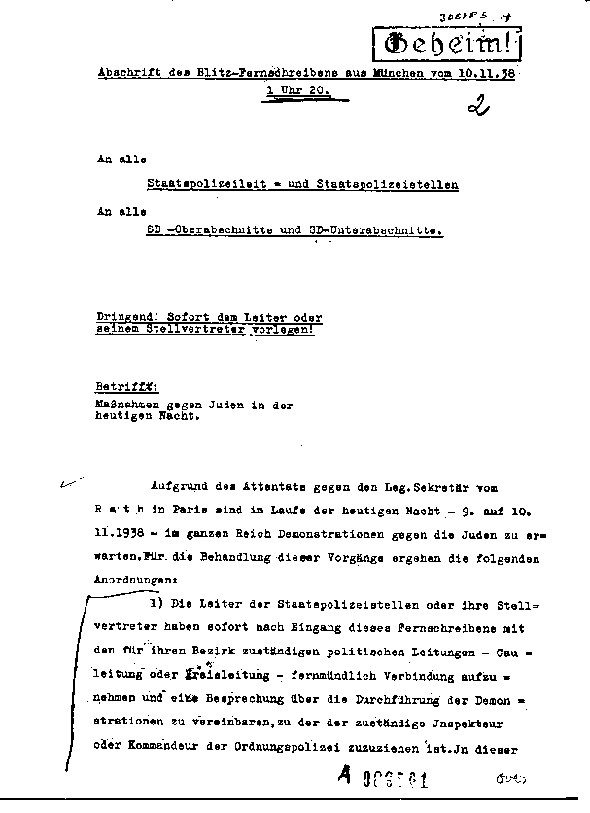
Telex signed by Reinhard Heydrich (page 1 of 4). National Archives [Public Domain], via Wikimedia Commons.

The telex on November 10, 1938 at 2:56 a.m.
Rudolf Hess sent out a cable to all the party offices throughout Germany. This telex forbade setting fire to Jewish shops: “On express orders issued at the very highest level, there are to be no kind of acts of arson or outrages against Jewish property or the like on any account and under any circumstances whatsoever.”[7] Forbidding the arson of Jewish shops was probably due to the fact that many Jews rented from non-Jews. Thus, burning these shops would actually destroy German property. There was also a risk that the fires would spread to adjacent German property. Finally, it became clear after the pogrom that the Nazis wanted to “Aryanize” the last Jewish-owned businesses in Germany—that is, the Nazis wanted to take them over and provide them to the so-called “Aryan” proprietors. In light of this eventual “Aryanization,” burning the shops and their contents would be counterproductive and wasteful in the long run.[8]
Sonuç:
Hitler'in yakın çevresindekilerden olan Josef Goebbels'in günlüklerinde, Hitler'in kendisine pogromu durdurma emri vermediği, bilakis pogroma izin verdiği görülmektedir. Goebbels'in günlükleri, pogromun gidişatından gece boyunca duyduğu heyecanı gözler önüne sermektedir. Ertesi gün Hitler'le görüştüğünde, geriye sadece pogromu sona erdirmenin ayrıntılarını kararlaştırmak kalmıştı. Hitler'in yakın çevresindekiler de dahil başka hiçbir Nazi yetkilisi pogromu durdurmaya çalışmadı. Bilakis, Kristallnacht gecesi boyunca, pogromun en iyi şekilde nasıl uygulanacağına dair talimatlar yolladılar. Bu Nazi yetkililerinin hiçbiri, Hitler'in izni olmadan Alman Yahudilerine karşı şiddet eylemleri başlatmaya veya özendirmeye cüret edemezdi.
NOTES
[1] David Irving, Goebbels: Mastermind of the Third Reich (Focal Point, 1996), p. 277. You may download the entire book as a PDF at www.fpp.co.uk/books/Goebbels/.
[2] David Irving, War Path (London 1978), p. 165 as cited in Richard J. Evans, David Irving, Hitler and Holocaust Denial, (4)(4.3)(c)(ii)(E)(2-4) at www.hdot.org, “Expert Witness Reports.” Warpath can be downloaded as a PDF at http://www.fpp.co.uk/books/WarPath/.
[3] Richard J. Evans, David Irving, Hitler and Holocaust Denial, Section (4)(4.3)(c)(ii)(E)(10).
[4] Richard J. Evans, David Irving, Hitler and Holocaust Denial, Section (4)(4.3)(c)(iii)(A)(4).
[5] Richard J. Evans, David Irving, Hitler and Holocaust Denial, Section (4)(4.3)(c)(ii)(F)(9).
[6] Richard J. Evans, David Irving, Hitler and Holocaust Denial, Section (4)(4.3)(c)(ii)(F)(2).
[7] Richard J. Evans, David Irving, Hitler and Holocaust Denial, Section (4)(4.3)(c)(ii)(G)(1).
[8] Richard J. Evans, David Irving, Hitler and Holocaust Denial, Section (4)(4.3)(c)(ii)(G)(2-4).