

Ce contenu est également disponible en :
Si personne n’a trouvé un ordre signé par Adolf Hitler ordonnant l’extermination des Juifs, cela signifie-t-il que l’extermination des Juifs n’a jamais eu lieu ?
Les négationnistes de la Shoah affirment que :
Personne n’a jamais trouvé un ordre signé par Adolf Hitler autorisant la Solution finale. L’absence d’un tel ordre d’exterminer les Juifs prouve que la Shoah n’a pas eu lieu.
Les faits sont les suivants :
Il est fort probable qu’il n’y ait pas d’ordre écrit d’Adolf Hitler autorisant l’extermination des Juifs. Au contraire, conformément à la politique nazie de secret et de tromperie, en particulier en ce qui concerne la Solution finale, Hitler a transmis oralement ses instructions pour le meurtre des Juifs. En outre, la Solution finale n’était pas une solution unique, mais une variété de solutions distinctes adoptées dans différents domaines à des moments différents, qui visaient toutes à atteindre le même objectif, l’extermination de tous les Juifs sous contrôle allemand.
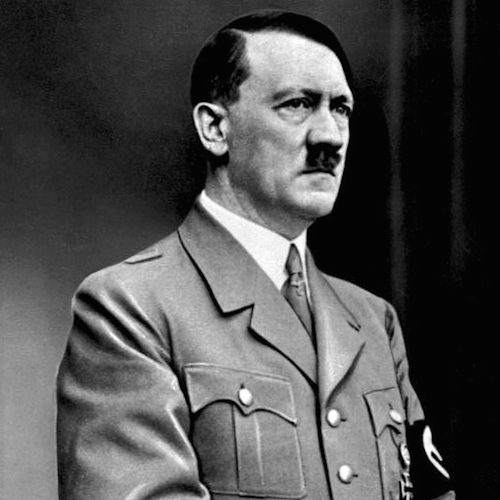
Bundesarchiv, Bild 183-S33882 / CC-BY-SA 3.0 [CC BY-SA 3.0 de (http://creativecommons.org/licenses/by-sa/3.0/de/deed.en)], via Wikimedia Commons

What specifically do Holocaust deniers say about Hitler’s authorization of the Final Solution?
David Irving, who the High Court in London declared to be a Holocaust denier, racist, and antisemite, offered “a thousand pounds to any person who could produce even one wartime document showing explicitly what Hitler knew, for example, of Auschwitz . . .”[1] On his website Irving states that: “Nobody has yet claimed the widely publicized $1,000 reward . . . for even one page of wartime contemporary evidence that Hitler was even aware of Auschwitz (’the Holocaust’) let alone gave the order for the Final Solution.”[2] Similarly, John Weir, writing on the American Holocaust denial website CODOH (Committee for Open Debate on the Holocaust), argues that if such an order was issued “it would have been located . . . Since none has been found, the conclusion is inescapable: There was no policy to exterminate Jews by the Nazi government.”[3]
Why is it unlikely that Hitler ever signed an order for the extermination of the Jews?
Secrecy and destruction of documents:
Hitler and the Nazi regime were secretive about the murder of the Jews. Hitler didn’t want to leave a trail of evidence that would inflame his own population or the leadership of other countries. On October 4, 1943, Heinrich Himmler, the head of the SS, gave a speech at Poznan (Posen, Poland) to a meeting of SS Major Generals. Here, he acknowledged how secret the ‘Final Solution’ was: “We will never speak of it publicly . . . I mean the evacuation of the Jews, the extermination of the Jewish race. The Jewish race is being exterminated—that is clear, it’s in our program–elimination of the Jews and we’re doing it, exterminating them . . . This is a page of glory in our history which has never been written and is never to be written . . .”[4]
Aside from the secrecy, Nazi officials ordered that any evidence of the Final Solution be destroyed as the Allies marched toward the German heartland. Rudolf Höss, the commandant of Auschwitz-Birkenau, wrote after the war that Adolf Eichmann (and his deputy Günther), “were the only ones who had the necessary information to calculate the total number of Jews annihilated. According to the orders given by Himmler, all information concerning the number of victims involved was to be burned after each action at Auschwitz . . . I personally destroyed every bit of evidence which could be found in my office. The other department heads did the same.”[5]
Hitler usually transmitted his controversial orders orally:
Hitler did sign an order for the T-4 euthanasia program. In the T-4 program as many as 100,000 German citizens who were thought to be ‘unworthy of life’ were murdered by Nazi party authorities and other German collaborators. When the German population caught on to what the Nazis were doing with T-4, they protested and Hitler was forced to publicly back down and cancel the program (although it continued secretly in the camps). Having been embarrassed by a written order once, Hitler became wary of doing it again. Important Nazi officials confirmed the oral transmission of Hitler’s secretive orders. For example, Adolf Eichmann wrote in his memoirs about the oral transmission of Nazi command: “Around the end of 1941 or the beginning of 1942 Heydrich, the Chief of the SIPO [Security Police] and SD [Security Service], told me in conversation that the Führer had ordered the physical destruction of the Jewish opponent.”[6] Eichmann asked for no written order. Hitler’s wish, as expressed through Himmler and Heydrich, was good enough for him. Hitler was even wary of discussing such commands with his inner circle, in order to distance himself from potential fallout. Peter Longerich, a historian at the University of London, has noted, “Hitler avoided giving a clear written order to exterminate Jewish civilians. He avoided speaking openly about killing in his entourage.”[7]
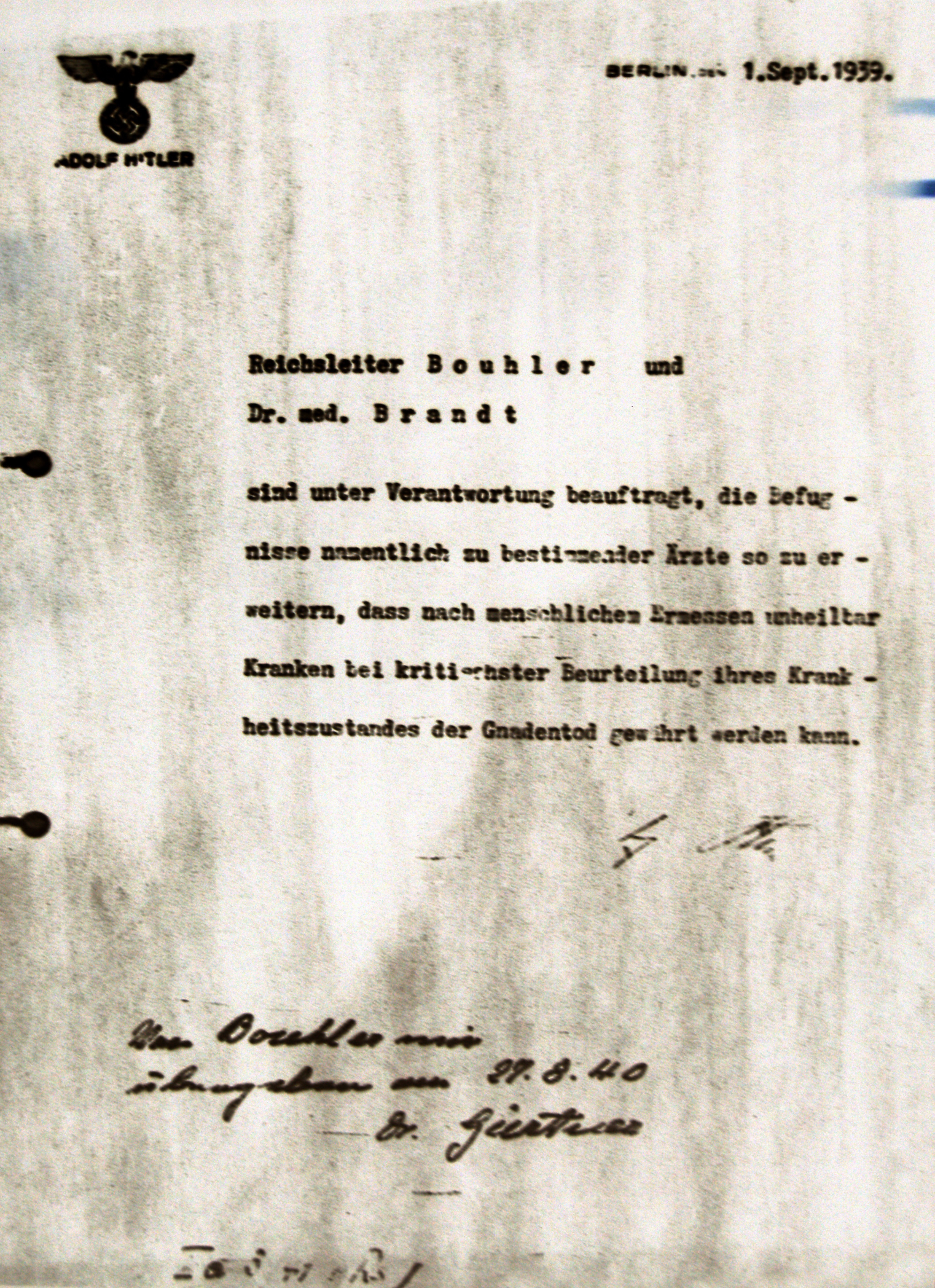
By Marcel (Own work) [Public domain], via Wikimedia Commons

The facts about the extermination of the Jews:
The murder of the Jews was actually many individual solutions implemented in different regions at different times. In Poland, the Germans set up ghettos, in which the Nazis and their collaborators systematically starved to death a large numbers of Jews, or left them to die of disease. The Nazis and their collaborators enslaved some Jews, working many of them to death in the camp system. The Nazis transported other Jews to the death camps of Treblinka, Sobibor, Belzec, and Chelmno, where they immediately murdered nearly all arriving Jews. The Nazis and their collaborators shipped Jews from other countries in Nazi-occupied Europe to the ghettos of eastern Europe or to Auschwitz-Birkenau, where nearly all of them were systematically murdered. Meanwhile, in the conquered territories of the Soviet Union, the Einsatzgruppen, or mobile killing squads, rounded up some 1,150,000 Jews from villages and towns, murdered them, and buried their bodies in mass graves. Reports detailing the activities of the Einsatzgruppen were regularly submitted for Hitler’s review. They chronicle with clinical precision the numbers of Jews these special killing squads “liquidated.” A report entitled “Report to the Führer on Combating Partisans,” (No. 51, December 1942) reported that 363,211 Jews had been executed. The report had been printed in the large type favored by Hitler, who hated wearing his reading glasses, and was signed by Heinrich Himmler, the head of the SS and a member of Hitler’s inner circle. It was marked “Shown to the Führer.”[8] If Hitler had not ordered these murders, why did he review and sign this report?
There is no one order for all of these actions, but there is a large and diverse body of paperwork that, when considered as a whole, documents the murder of the Jews.
Conclusion :
Il n’y avait très probablement pas d’ordre écrit par Hitler concernant l’extermination des Juifs. Pourquoi ? Premièrement, ce n’était pas une solution unique, mais une variété de solutions distinctes qui ont eu lieu dans différents domaines, à des moments différents, et de différentes façons. Toutes les solutions en question visaient à atteindre le même objectif : l’extermination de tous les Juifs sous contrôle nazi. Deuxièmement, Hitler et son cercle proche cherchaient autant que possible à éviter de laisser des preuves papier. Hitler et d’autres hauts fonctionnaires nazis ont transmis ces ordres potentiellement controversés oralement et, quand la guerre a été apparemment perdue, ils ont cherché à détruire tous les documents liés au meurtre des Juifs. Cela signifie que, même s’il y a eu un jour un ordre écrit, il a probablement été détruit. Ainsi, il ne fait pas sens d’affirmer, comme les négationnistes de la Shoah le font, que parce qu’un morceau de papier ne peut pas être trouvé, le programme d’extermination n’a jamais été appliqué.
NOTES
[1] David Irving, Hitler’s War (Focal Point, 2001), Introduction, p. xxvii. This book can be downloaded in PDF form at http://www.fpp.co.uk/books/Hitler/text/index.html.
[2] See “Dredged up from the Cesspit: A fascinating new study of Hitler” at http://www.fpp.co.uk/docs/Irving/cesspit/HSJP210898.html.
[3] John Weir, “The Plum Cake,” The Revisionist at http://codoh.com/library/document/442.
[4] Document 1919-PS as excerpted in Michael Berenbaum, Witness to the Holocaust: An Illustrated Documentary History of the Holocaust in the Words of Its Victims, Perpetrators and Bystanders (HarperCollins, 1997), pp. 176-180.
[5] Rudolph Höss, Death Dealer: The Memoirs of the SS Kommandant at Auschwitz (edited by Steven Paskuly) (Prometheus Books, 1992), pp. 38-39.
[6] Heinz Peter Longerich, Hitler’s Role in the Persecution of the Jews by the Nazi Regime (“Conclusion”, 20.6) at https://www.hdot.org.
[7] Rudolf Aschenauer (ed.), Ich, Adolf Eichmann: Ein historischer Zeugenbericht (Leoni am Starberger See: Druffel, 1980), pp. 177, 178, 229 as cited in Robert Jan van Pelt, The Van Pelt Report (“XI Irving Adrift [1993-1998]”) at https://www.hdot.org.
[8] Richard J. Evans, David Irving, Hitler and Holocaust Denial, Section (5)(5.3)(c)(vii) at https://www.hdot.org and Christopher Browning, Evidence for the Implementation of the final Solution, Section (IV)(A) at https://www.hdot.org.