

این پست به این زبان ها نیز موجود است:
اگر تعدادی از یهودیان از روند اخراج به تربلینکا، بلزک و سوبیبور جان سالم بدر برده باشند، آیا این موضوع به این معنی است که این اردوگاهها ترانزیتی بوده و اردوگاه مرگ نبودهاند؟
انکارکنندگان هولوکاست مدعی هستند که:
A handful of Western European Jews survived their deportation to Sobibor. If the Operation Reinhard camps were “death camps,” there should have been no survivors at all. The Sobibor camp—and by extension Belzec and Treblinka (also Operation Reinhard camps)—must not have been a death camp, but a transit camp.
More specifically, Carlo Mattogno, an Italian Holocaust denier, documented 101 male Jews who were deported from the Theresienstadt ghetto to Osawa-Sobibor on May 9, 1942. These Jews did not die at Sobibor, but rather died at the Majdanek concentration camp in Lublin, Poland. Mattogno asserts that this means Sobibor, Treblinka, and Belzec were not death camps, but transit camps. From these transit camps, Jews were pushed further east [1]
واقعیت این است که:
شواهد نشان میدهد اکثر یهودیان اروپای غربی که به سمت شرق اخراج شدند بلافاصله پس از رسیدن به سوبیبور، بلزک و تربلینکا کشته شدهاند. با این حال نازیها برخی از آنها را بعنوان برده در خود اردوگاههای مرگ یا اردوگاههای کار اجباری در همان حوالی بکار میگرفتند. از این رو، تنها بخش ناچیزی از ۲۵۰,۰۰۰ یهودی غرب اروپا از روند تبعید به تربلینکا، بلزک و سوبیبور جان سالم بدر بردند. این حقیقت که این اردوگاهها، اردوگاه مرگ بوده اند به موجب این مسئله تغییری نمیکند.
سرنوشت یهودیان اروپای غربی که به شرق تبعید شدند:
حدود ۲۵۰,۰۰۰ یهودی در خلال جنگ جهانی دوم از آلمان، فرانسه، اسوواکی، اتریش، اراضی چکسلواکی سابق و هلند به لهستان و اراضی شوروی اشغالی تبعید شدند. نازیها قصد داشتند این سفری یکطرفه باشد و در نهایت به مرگ آنها ختم شود. با این حال، از یک شهر یا اردوگاه ترانزیت در غرب اروپا تا یک گور دستهجمعی در یکی از اردوگاههای مرگ همیشه مسیر مستقیمی وجود نداشت. به طور کلی، یکی از دو حالت زیر برای یهودیان غرب اروپا اتفاق میافتاد:
- اکثر یهودیان منتقل شده از غرب اروپا بلافاصله پس از رسیدن به اردوگاههای مرگ عملیات راینهارد کشته میشدند. با افزایش نیاز به نیروی کار در اردوگاههای مرگ، برخی مردان یهودی برای کار در یگان ویژه مرگ (سوندرکاماندو) انتخاب میشدند. این جزئیات کاری از ضروریات نیروی کار اجباری بود که نازیها با استفاده از آن اردوگاه را سر پا نگاه میداشتند.
- نازیها برخی از یهودیان غرب اروپا را انتخاب و مسیر آنها را به سمت محلههای یهودینشین یا اردوگاههای کار اجباری در لهستان یا اراضی اشغالی شوروی تغییر میدادند. آنها غالباً بر اثر گرسنگی، بدرفتاری، یا اعدام در این مکانها میمردند.
چه تعداد از یهودیان غرب اروپا به مکانهای دیگری برده شدند؟ چه تعدادی از آنها در اردوگاههای عملیات راینهارد مردند؟ اکنون به دو پیامد «اسکان مجدد» در شرق نگاهی بیاندازیم.
The majority of Western European Jews: Murdered upon arrival
The Nazis and their collaborators murdered upon arrival the majority of Western European Jews sent to the Operation Reinhard death camps. How do we know? Only a few transports from Western Europe to Eastern Europe actually had any survivors. A example will illustrate how only a tiny minority of Western European Jews survived deportation to Operation Reinhard camps. Between March 2, 1943 and July 20, 1943, the Nazis sent 34,313 Jews from the Westerbork transit camp in the Netherlands directly to Sobibor on 19 transports [2]. Of the 34,313 Jews on these transports, only 18 Jewish men survived the war. Holocaust deniers have to then consider the follow-up question: where did the other 34,295 Jews from Westerbork go? If all of them had been transported to the East for work detail, as Holocaust deniers claim, it is far more likely that a larger number than 18 would have returned after the war. The sheer minority who survived these transports shows that the Nazis and their collaborators murdered the vast, vast majority, usually directly upon arrival at Sobibor.
Western European Jews sent to ghettos or labor camps in the East:
Holocaust denier Carlo Mattogno argues that that since 101 German and Czech Jewish men survived a transport to Sobibor on May 9, 1942, this must mean that it was not a death camp but a transit camp. Contrary to Mattogno’s erroneous claims, the Germans actually had established a labor camp at Osawa, which is on the rail line to Sobibor. When the transport in question stopped at Osawa, the Nazis selected some of the Jewish men to work in the Osawa camp. The Nazis sent the remainder of the transport—women, children, elderly, infirm, and the unselected men—to Sobibor, where they were all murdered on arrival. Later, the Nazis transferred some of the Jews in the Osawa labor camp to the Majdanek concentration camp in Lublin, Poland [3]. By being rerouted away from the death camps, a small number of Jewish men were able to survive the horrors of the concentration camp and live to tell their story.
How do we know that the Nazis selected some Western European Jews for manual labor? Several Jewish deportees from Western Europe testified that the Nazis selected them for forced labor, redirecting them from their original destination, the flames of Sobibor. Jules Schelvis, a Jewish man from Holland, was deported on June 1, 1943, along with 3,005 other Jews, including his wife Rachel and her family. On his arrival at Sobibor, the Nazis selected him, with 79 other Jewish men, for work in Dorohucza, a nearby labor camp for digging peat. [4] The remaining 2,875 Jews in Schelvis’s transport (including his wife and her family) disappeared.
From another witness: Albert Adejes, a French Jew, was deported to Sobibor on March 4, 1943. He recalled that after a six-day journey: “We had to get off the train and step into the ice-cold night. When we had all gathered between two or three SS barracks, they asked us if we wanted to work. I was one of forty who stepped forward and volunteered. The others stayedd back. Forty of us went straight back into the wagons that had taken us from Drancy to Sobibor.”[5] Adejes was one of only four Jews from this transport (out of forty) to survive, eventually ending up at Auschwitz-Birkenau by the end of the war [6].
Excavations at Belzec: The Case of Max Munk.
To settle the issue once and for all, Professor Andrzej Kola, director of the Institute of Archeology and Ethnography at the Nicolaus Copernicus University (Torun, Poland), surveyed the Belzec camp from 1997-1999. He wanted to locate the mass graves, and in midst of his search investigators found the lid of a silver cigarette case with the inscription: “Max Munk, Wien 27.” With some further research, it was found that Max Munk was born in Vienna in 1892; he was deported to Theresienstadt via Prague on December 17, 1941, arriving on Transport N. From Theresienstadt; he was sent on transport ‘Ag’ to the transit ghetto in Piaski on April 1, 1942. Ultimately, Munk was placed on another transport to Belzec from the Piaski ghetto. Munk’s ashes are buried somewhere in Belzec, but his cigarette case is evidence that Belzec was, for him and some 450,000 other Jews, the final destination [7].
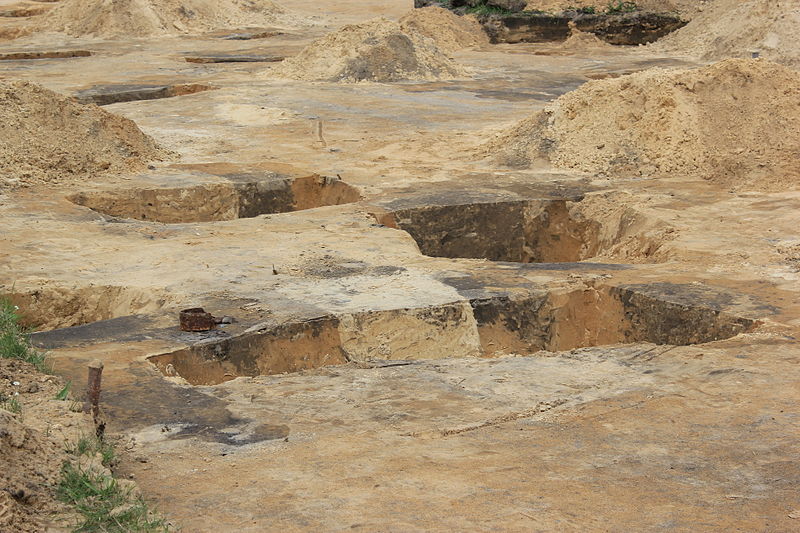
Excavation Site at Sobibór. By Julian Nitzsche (Own work) [CC BY-SA 4.0 (http://creativecommons.org/licenses/by-sa/4.0)], via Wikimedia Commons
نتیجهگیری:
شواهد نشان میدهد اکثر یهودیان غرب اروپا که به شرق تبعید شدند بلافاصله پس از رسیدن به سوبیبور، بلزک و تربلینکا به قتل رسیدند. برخی اوقات نازیها تعداد اندکی را برای کار در اردوگاههای کار یا برای کار در یگان ویژه مرگ یهودیان در اردوگاههای مرگ انتخاب میکردند. انکارکنندگان هولوکاست چنین استدلال میکنند به دلیل اینکه تعداد اندکی از یهودیان اروپای غربی از کاروانهای ارسالی به سوبیبور جان سالم به در بردهاند، این اردوگاهها باید به طور کلی اردوگاه ترانزیتی بوده باشند. استدلال انکارکنندگان اعتباری ندارد. دلایل روشنی وجود دارد که نشان میدهد چرا یک اقلیت جزئی از یهودیان تبعیدی از غرب اروپا از اردوگاههای مرگ جان سالم به در بردهاند. از طرف دیگر اکثر یهودیان تبعید شده به سوبیبور – یا بلزک و تربلینکا – به محض رسیدن به قتل رسیدهاند.
NOTES
[1] Carlo Mattogno, Belzec in Propaganda, Testimonies, Archeological Research, and History (Theses & Dissertations Press, 2004), (“Table 1”), p. 112 at http://vho.org/dl/ENG/b.pdf.
[2] Jules Schelvis, Sobibor: A History of a Nazi Death Camp (Berg, 2007), pp. 198, 199.
[3] Martin Gilbert, Holocaust Journey: Travelling in Search of the Past (Columbia University Press, 1997), p. 248.
[4] Schelvis, Sobibor, p. 4.
[5] Ibid., p. 217.
[6] Ibid., p. 217.
[7] Robin O’Neill and Michael Tregenza, “Archeological Investigations: A Review by Historians,” Holocaust Education and Archive Research Team, 2007, www.holocaustresearchproject.org/ar/modern/archreview.html. See also Andrzej Kola, Belzec: The Nazi Camp for Jews in the Light of Archaeological Sources, Excavations 1997-1999 (Council for the Protection of Memory of Combat and Martyrdom and United States Holocaust Memorial Museum, 2000), “Summary, Figure 95,” p. 76.